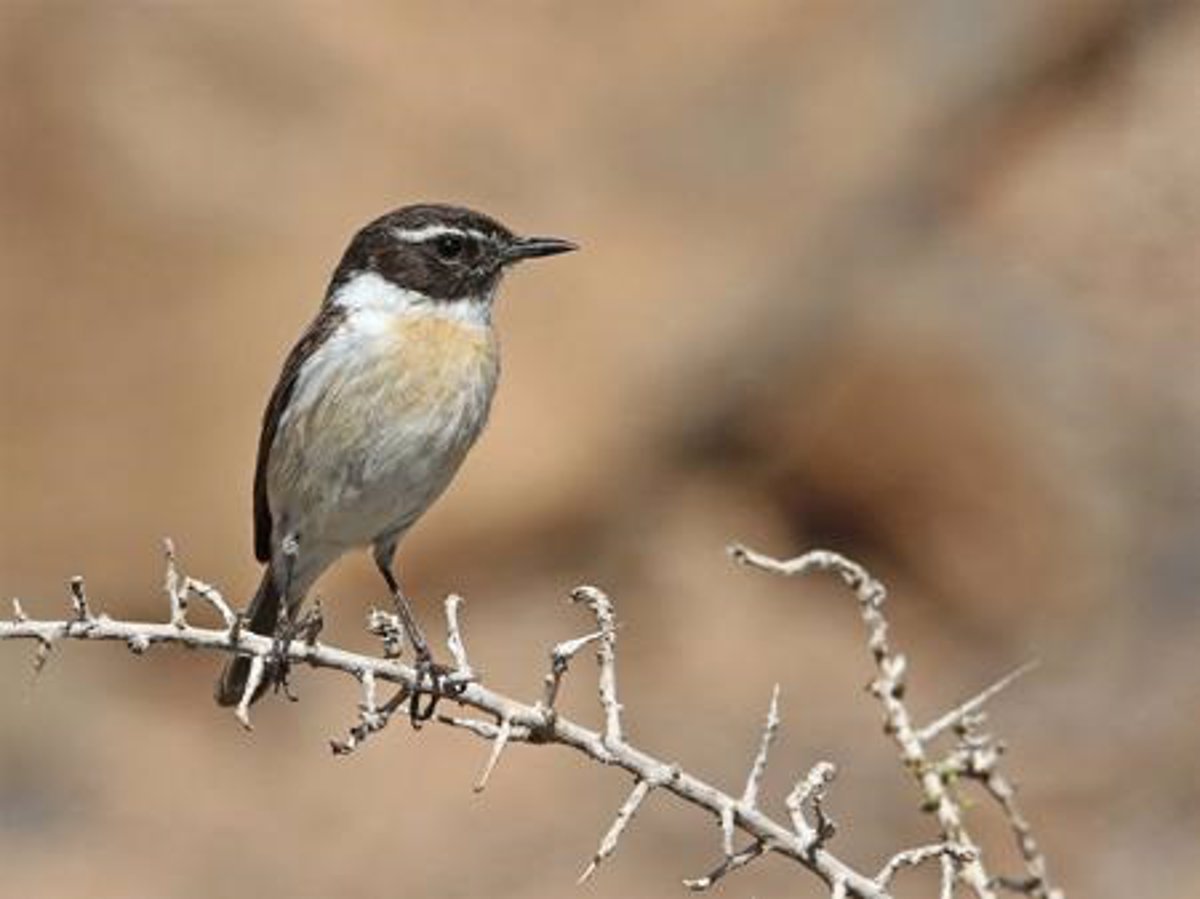
The reduction of rainfall on the island of Fuerteventura has led to a decrease of between 63 and 70 percent in the Canary Chat (Saxicola dacotiae), according to a study by the National Museum of Natural Sciences (MNCN.CSIC) and the University of Oviedo published in the journal Science of The Total Environment.
The population of the Canary Chat, which is only found in Fuerteventura, is currently estimated at 4,500 individuals, with an average density of three birds per square kilometer, almost three times less than recorded two decades ago (8 birds/km2), as reported by the MNCN.CSIC in a press release.
In this regard, they point out that the «main cause of the decline» of this endemic bird is «directly related» to the reduction in precipitation on the island. They indicate that this «drastic» decrease in the population «has occurred under the same pattern» of habitat preferences of the species, mainly linked to semi-arid shrublands, well preserved on steep slopes.
The lack of rainfall, they indicate, directly affects the primary productivity of the island and, therefore, the availability of food for the Canary Chats, negatively impacting «their breeding success». In dry years, females may not lay eggs, causing a decrease in the number of breeding individuals in the following years.
University of Oviedo researcher Juan Carlos Illera explained that considering the species has an average lifespan of three to five years, «several consecutive years of drought can have a severe impact on the population».
TWO-THIRDS OF THE POPULATION HAVE BEEN LOST
The Canary Chat is an endemic bird of Fuerteventura where two-thirds of its population have been lost in the last 20 years, noting that for this research they have «accurately replicated» the methodology used almost two decades ago to assess the changes in the population of Canary Chats on the island between 2005-2006 and 2024.
The same 1,287 transects, or linear routes of 500 meters, were surveyed, characterizing the vegetation structure in each one through circular plots distributed along the route. MNCN researcher Luis María Carrascal explained that to ensure «reliable comparisons of density and population sizes, the probability of detecting birds in both periods was calculated, thus eliminating possible biases».
It was also analyzed the temperature and precipitation conditions during the three years prior to each census, allowing to relate «population changes with variations in environmental conditions that affect the survival and reproduction of the species».
Detailed analysis of meteorological data reveals that temperatures remained relatively stable between both study periods, but precipitation during the three years prior to the 2024 census was 40 percent lower than in the previous 2005-2006 period.
This reduction was «even more pronounced» (62%) during the critical months for the species’ reproduction. The decrease in rainfall significantly affected the primary productivity of the island, reducing the vegetation cover on which the Canary Chat depends and, consequently, «impacting the reproductive success of the species».
The effect of this situation is reflected in the fact that currently the species requires a larger area (246 km2 for 50% of the population and 514 km2 for 75%) than in 2005-2006 (195 km2 and 434 km2, respectively) to accommodate the same proportions of the population.
Therefore, in the face of habitat loss, it is one of the problems that numerous species, including the Canary Chat, are facing. Needing more space to maintain the same population proportion exacerbates the problem in very limiting environmental situations.
«One particularly concerning aspect is the reduced effectiveness of Bird Special Protection Areas (SPAs) in conserving the species,» Carrascal emphasized, adding that while in 2005-2006 more than 60 percent of the population was within SPAs, in 2024 this figure has decreased to just over 52 percent, despite a slight increase in protected area.
«This situation, coupled with climate predictions forecasting increased aridity in the Canary Islands, raises uncertainty about the species’ future viability,» he concluded.
Finally, they point out that monitoring of insular endemic species «is crucial» for their conservation, especially when it comes to birds that inhabit very small territories and maintain small populations. These species are particularly vulnerable, as evidenced by the fact that 50 percent of all threatened species in the world live on islands, even though they represent only 7 percent of the earth’s surface.
To assess their conservation status, they emphasize, «it is essential» to analyze changes in their populations and distribution areas, considering both habitat alterations caused by human activity and the effects of climate change.