
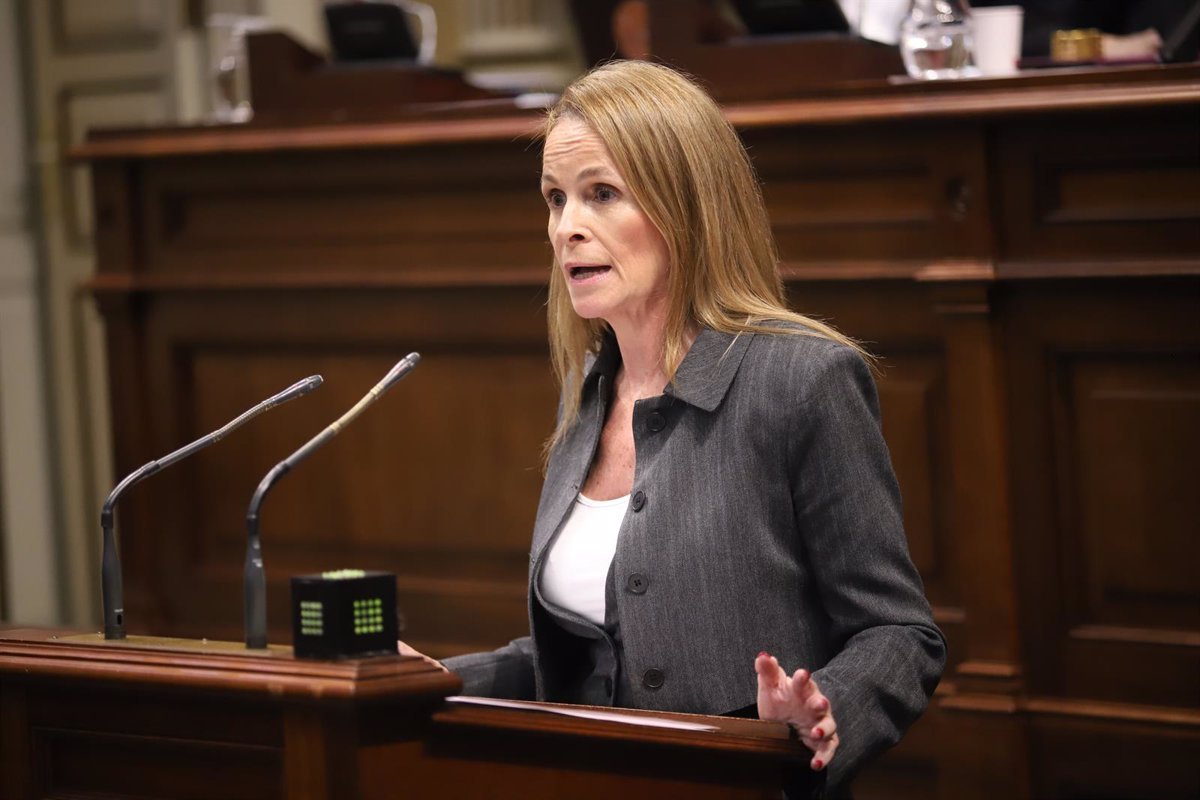
The plenary session of the Parliament of the Canary Islands condemned on Wednesday, with the Socialist Group voting against, the illegal occupation of homes and any private property.
The Non-Legislative Proposal presented by the Popular Group also requests, with the support of the four-party groups and the rejection of PSOE and NC-BC, the repeal of the state housing law, the unblocking in the Courts of a bill to activate the eviction of squatters within 24 hours, increase penalties, annul the registrations of illegal occupants of homes in the municipal registry, and the creation of specialized courts in occupation and ‘inquioccupation’.
PP spokesperson, Luz Reverón, indicated that illegal occupation has increased by 76% in the Canary Islands since Pedro Sánchez came to power, totaling 4,000 homes, amid the «inaction» of the central Government, which considers it a «minor issue».
She mentioned that this initiative «comes from listening to the people» and not from the «offices of Génova,» emphasizing that home occupation is «not a system failure» but a model that prefers «propaganda over reality.» «Those who illegally occupy a home have more guarantees than the property owner,» she added.
She also criticized President Pedro Sánchez’s «smoke and mirrors» when announcing 184,000 homes that have not been built, and emphasized that the PP «says enough» to end laws that «mistreat» citizens. «Housing cannot be an electoral toy for a president in trouble,» she stated.
Carmen Hernández (NC-BC) pointed out that her party is against illegal occupation but warned that the best way to address it is for institutions to have a «real» housing policy and for homes to stop being «commodities.»
She criticized the «fear-mongering» campaign promoted by the PP because «it is not justified by the data, it is a lie,» and reproached the Popular Party for maintaining a «deafening silence» about the 338 evictions that have occurred in the first quarter and for not wanting to limit rental prices.
Socorro Beato, from the Nationalist Group, stated that the right to private property «is being trampled on,» for example, in the Toscal neighborhood, in Santa Cruz de Tenerife, criticizing that the state law «does not protect the owner.»
She also noted that «a business has been made of occupation» and therefore called for «mechanisms» to expedite all procedures.
VOX SUSPECTS «POLITICAL OPPORTUNISM» BY THE PP
Paula Jover (Vox) praised her group’s initiative to introduce occupation into the «political debate» in the face of the «indifference and even criticism» of the other political parties in the Canary Islands. «We hope this is not political opportunism,» she said.
She stated that occupation is a «serious phenomenon» and a «blight,» and urged the PP to request the complete repeal of the housing law and to create a shock plan through Icavi to assist victims.
Raúl Acosta, spokesman for the Mixed Group (AHI), refused to set limits on rental prices due to the limited public housing supply in the archipelago, and called for «realistic measures, not populist ones,» to defend property owners and facilitate access to housing.
Melodie Mendoza (ASG) commented that occupation «generates insecurity, deteriorates neighborhood coexistence, and leaves people defenseless,» emphasizing the need to find a «balance» between defending rights and allowing the population to enjoy a home. «It’s not about choosing between legality or solidarity,» she stated.
Patricia Hernández (PSOE) criticized CC for supporting the NLP when the Housing Minister, Pablo Rodríguez, warned of the «alarmism» about occupation not being supported by data. «They are probably being carried away by a debate that Coalition Canaria has not sustained during this time,» she explained.
She lashed out at the PP for «mixing everything up» with an initiative that seeks to create «social alarm» by including «breaking and entering, usurpation, and non-payment of rent, among other things.»
