
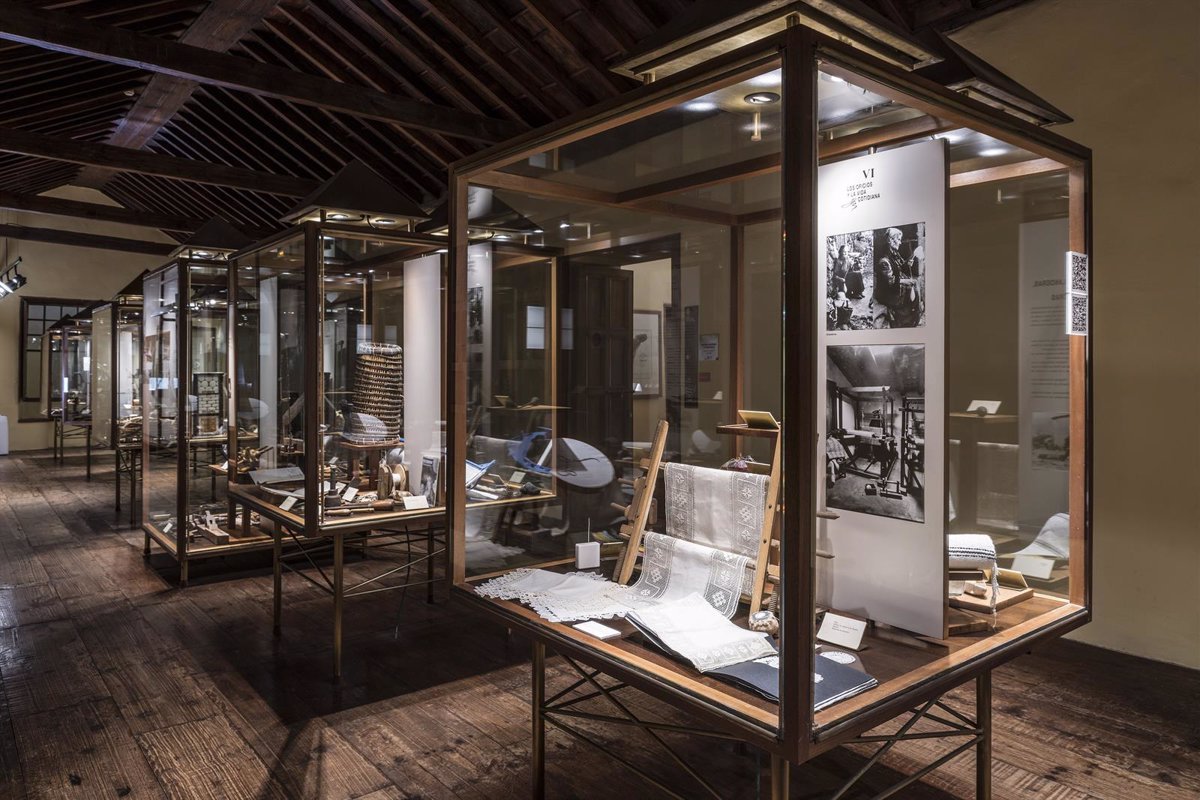
The Cabildo de Tenerife, through the Culture and Museums area of Tenerife, will invest over one million euros in the improvement and update of the permanent exhibition at Casa Lercaro, one of the headquarters of the Museum of History and Anthropology of Tenerife (MHA), located on San Agustín Street, La Laguna.
This is an initiative for the modernization of this space, which will take place without closing the museum and during three years of work, in order to face the «most important update in content and museography since its creation.» Thus, the investment will be carried out in three phases.
In this way, in 2026, there will be an amount of 343,684 euros; 349,569 euros in 2027, and 354,277 euros in 2028, as announced by the Vice President of the Cabildo de Tenerife, Lope Afonso, in a press release.
Furthermore, this update aims to «create a space where culture, conservation, and the dissemination of the past to which we are heirs is an interactive place that invites investigation,» warned the Councilor of Culture, José Carlos Acha.
They recall that along with research, conservation, dissemination, and exhibition tasks of the funds and collections of the history of Tenerife, Casa de Lercaro, from the late sixteenth century, also offers a varied program of cultural and educational activities coordinated with Casa de Carta, the other headquarters of the MHA.
RENOVATION
The team of the museum has proposed the renovation of the permanent exhibition through a process with three annual executables that will be implemented successively.
Thus, work is being done on the drafting of the new discourse, the selection of pieces that accompany and illustrate it, as well as on the contracts and administrative processes necessary to materialize it.
In this process, they point out, there has been collaboration from different Areas and Departments of the OAMC (Autonomous Museum and Centers Organization) to which it belongs.
The current exhibition, influenced by the Annals School of Marc Bloch, addresses the history of Tenerife from the analysis of economic processes and social structures, presenting as the main thread the theory of Canarian monocultures.
Thus, the exhibition covers stages from sugar in the sixteenth century to bananas, potatoes, and tomatoes in the nineteenth and twentieth centuries along with tourism as a kind of «monoculture» that sustains the present economy.
This basic scheme is enriched with an area dedicated to the Lercaro family, builders and first inhabitants of the building of the same name, which closes the tour.
The new approach relocates collections and areas, which will be reduced and renamed. Three large blocks will integrate with the existing ones. Issues such as identity, gender, or decoloniality underlie the purposes of the new discourse.
Additionally, they emphasize that the proposal will allow the incorporation of collections that have been away from public view because they were in storage areas. The funds have been growing exponentially since 1993 when it was inaugurated as an atypical model of a Museum without a pre-existing collection.
READAPTATIONS
According to the Cabildo, the improvement project aims to reuse most of the existing exhibition furniture (panels, showcases, lighting, etc.), whose design has endured well over time, to adapt them to a new museographic design and modify some characteristics.
Thus, the improvement of accessibility to the exhibited collections by conservators or the incorporation of new systems related to their conservation will be taken into account.
Other notable aspects will be the contribution of new data on the history of Tenerife, resulting from advances in research, which will enrich the public’s knowledge of the island’s history, or the use of new technologies such as AI, which, when applied from an ethical consideration, will undoubtedly make the visitor experience more attractive. New learning algorithms, interactivity, and participation will be possible.
