
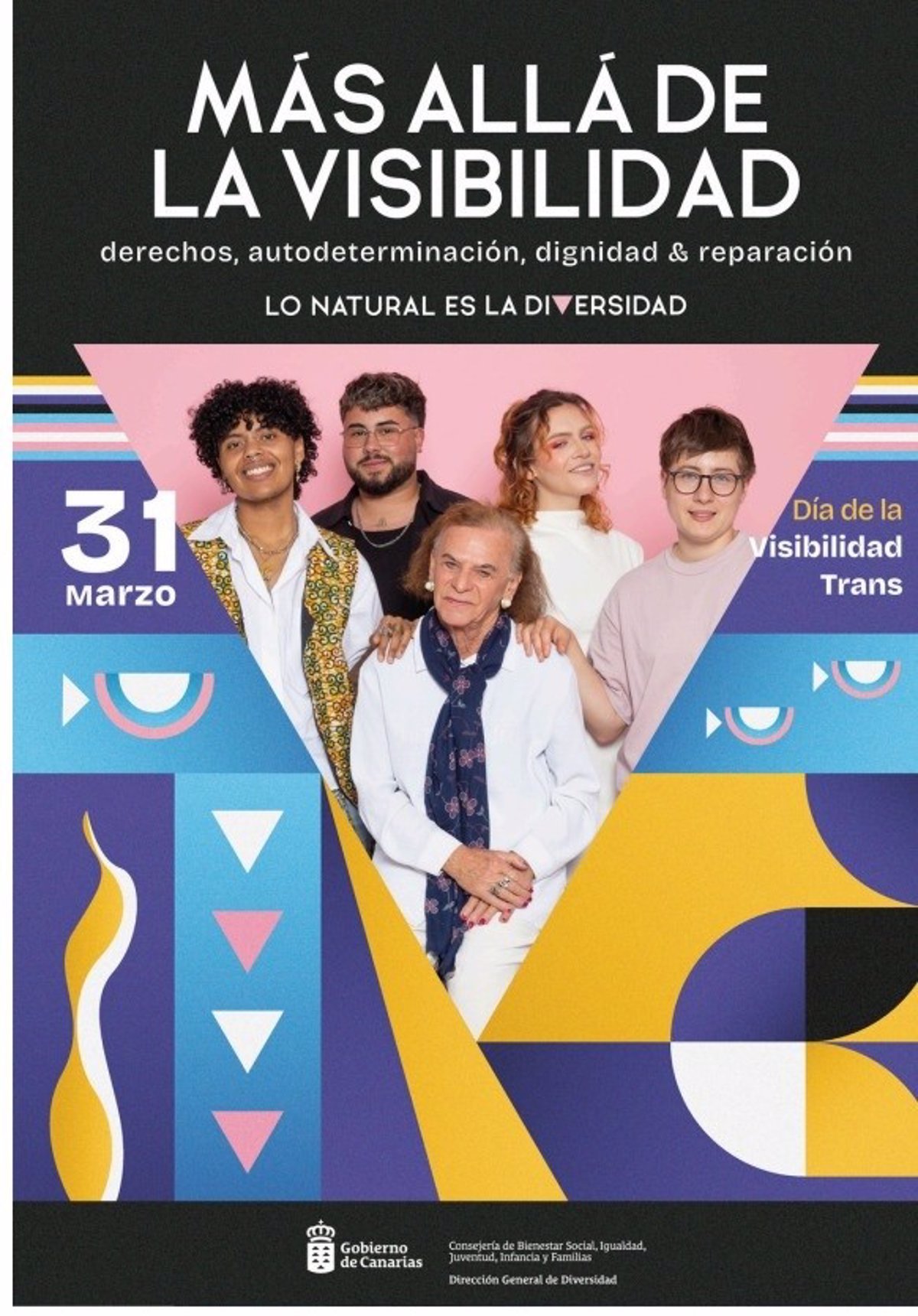
The Government of Canarias has launched a social media campaign with the slogan ‘Beyond visibility: rights, self-determination, dignity, and reparation’ aimed at advocating for the human rights of trans people, raising awareness, and preventing social biases in commemoration of ‘Trans Visibility Day’.
The Director General of Diversity, Celso Mendoza, states that the campaign «seeks to recover democratic memory and advocates for reparation against the pathologization, dehumanization, discrimination, and prejudices to which trans people have historically been subjected.»
Beyond visibility because, as expressed by trans collectives, «visibility without material changes can lead to a path of violence,» it details.
Mendoza also emphasizes «rights and self-determination since, as Amnesty International defends, it is crucial to create gender self-determination mechanisms that are not pathologizing, that are based on free choice.»
Likewise, «dignity and reparation to advocate for dignity and reparation in the face of all the historical transphobia, discrimination, and oppression, as well as historical memory so that no one else has to live feeling that they have to ask for permission or forgiveness just for being who they are or for living freely their orientation, corporality, identity, and/or gender expression.»
In this sense, the campaign socially recognizes the people who have faced and continue to face structural discriminations and values their activism as a reference in the fight for the rights of the community: Laura Mendoza, known as ‘La Lecherita’, Rioko Fotabón, Noah Cano, Alex García, and Marta Ángel.
The creative direction has been carried out by Nadia Martín, a photographer and journalist specialized in social issues with a class and gender perspective.
Rioko Fotabón, a poet and co-star of the campaign, says that they aim to «break the chains that imprison the wings,» that one can «live better,» and that existence belongs to all people.
In this regard, Marta Ángel, another protagonist, asserts that «happiness is not in fitting into a mold that is too small for you.»
PINK TRIANGLE
Regarding the elements and symbolism of the poster, the pink triangle is reclaimed as a symbol that aims to recover the historical memory of the repressions experienced by LGTBIQ+ people.
Currently, it is used by numerous groups as a symbol of resistance against LGTBIfobic discrimination, as it was used to mark sex-gender dissidences, who were persecuted and imprisoned simply for not fitting into the established norm.
This symbol was a tool of oppression, but over time it has been reclaimed by LGTBIQ+ movements as a sign of struggle and resistance.
By using it, the progress made is recognized, the violence committed is remembered, and advocacy is made for reparation, dignity, and the fight against hate speech, as stated in a government note.
The campaign it is part of, ‘Natural is diversity,’ aims to destigmatize and confront the prejudices, rumors, and stereotypes often associated with LGTBIQ+ community members.
As Celso Mendoza delves into, «fortunately, we have made progress and Canarias is a pioneer in laws and social movements that defend the rights of community members, but it is evident that we must continue to fight against lingering stigmas.»
