The jury of TAC! Urban Architecture Festival, an initiative promoted by the Ministry of Housing and Urban Agenda (Mivau) in collaboration with the Arquia Foundation, has selected the winning projects of the ideas competition for the construction of the two temporary pavilions for its fourth edition. The winning projects are ‘Espartal’ for Casa Mediterráneo in Alicante, and ‘De roca madre’ for Plaza de Stagno in Las Palmas de Gran Canaria.
The ‘Espartal’ project was designed by ELE Arkitektura, GA Estudio, architect Florencia Galecio, and architect Juan Gubbins, while ‘De roca madre’ was created by architects Alejandro Carrasco Hidalgo, Eduardo Cilleruelo Terán, Alberto Martínez García, and Andrea Molina Cuadro.
TAC! 2025, in collaboration with the City Council of Las Palmas de Gran Canaria and Casa Mediterráneo, aims to explore «the cultural richness that defines the intersection of territories united by the sea and to reclaim public space as a meeting place and a boundary» where «histories, identities, and ways of living converge,» as stated by Mivau in a press release.
According to Iñaqui Carnicero, Secretary General of Urban Agenda, Housing, and Architecture and president of the jury, «the TAC! festival advocates for architectural quality as a driver of urban and social transformation, promoting a dialogue between the city and its inhabitants based on experimentation, innovation, and commitment to the environment.»
«ROOTED ARCHITECTURE»
The projects recognized in this edition are described by Mivau as embracing «architecture rooted in the territory, engaging with local history, and revaluing the use of traditional materials as tools for a more sustainable future.»
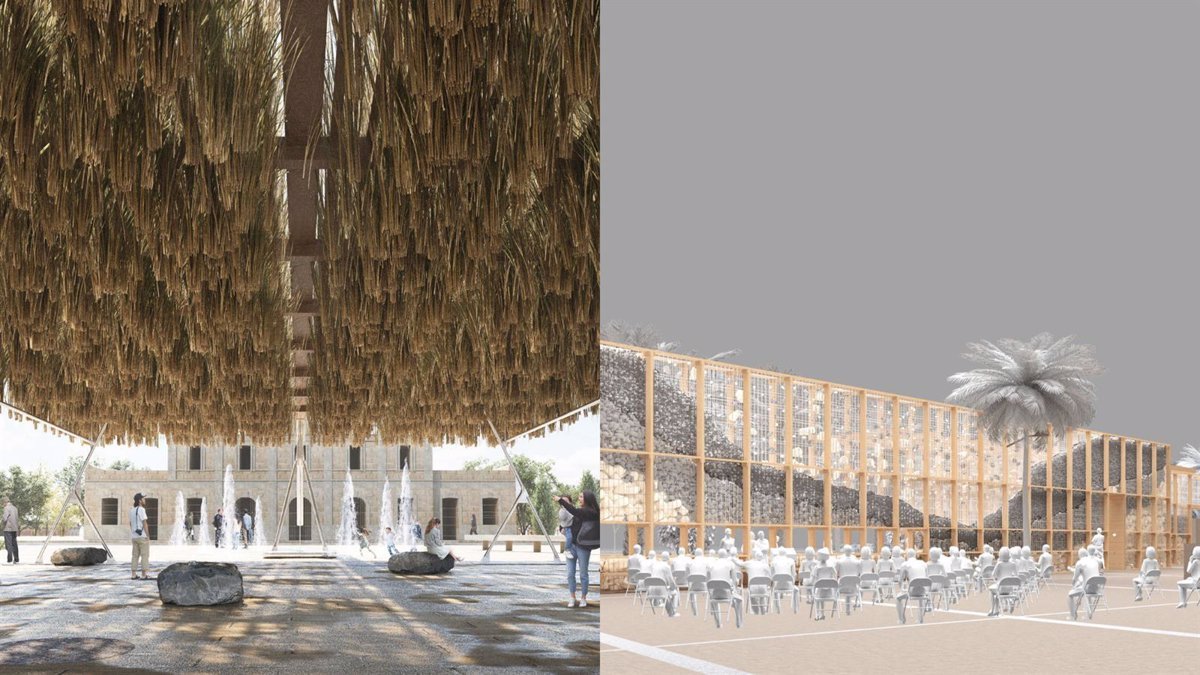
In the case of ‘Espartal’ (Casa Mediterráneo, Alicante), the design of the project is inspired by esparto, an «autochthonous and traditional» material that is no longer in use in architecture. On the other hand, ‘De roca madre’ (Las Palmas de Gran Canaria) uses native stones and plastic waste collected from the beaches of Gran Canaria to reflect on «the contrast between the deep time reflected in the island’s strata and the accelerated human impact on its ecology in recent decades.»
The festival jury, gathered at La Casa de la Arquitectura in Madrid, positively highlighted how the winning proposals present «contextualized interventions, attentive to the physical and social characteristics of the place, emphasizing their function as spaces of interaction in the urban fabric.»
PROPOSALS
In the current context of «extreme» climate conditions, the ‘Espartal’ pavilion, located at Casa Mediterráneo Alicante from October 16 to November 14, proposes a suspended ceiling made of esparto that filters light, creating a dense shade that provides thermal comfort and modifies the microclimate of Plaza Arquitecto Miguel López.
The initiative by ELE Arkitektura, GA Estudio, architect Florencia Galecio, and architect Juan Gubbins aims to «reverse» the obsolescence of esparto and «revalorize» its use by linking agricultural landscapes with the city, promoting a broader ecological cycle in the use of materials and valuing local material culture from an environmental, functional, and symbolic perspective.
On the other hand, the ‘De roca madre’ pavilion, to be installed from October 30 to November 28 in Plaza de Stagno in Las Palmas de Gran Canaria, will showcase a geological and anthropocene section using different types of stones from the coasts of Las Palmas de Gran Canaria and plastics collected by the Precious Plastic Gran Canaria collective, inviting reflection on «the contrast between the deep time reflected in the island’s strata and the accelerated human impact on its ecology in recent decades.»
The initiative by Alejandro Carrasco Hidalgo, Eduardo Cilleruelo Terán, Alberto Martínez García, and Andrea Molina Cuadro, on one hand, «looks to the past, evoking traditional Canarian construction in stone and wood, with geological and natural materials typical of the island,» and on the other hand, «opens a critical conversation with a contemporary issue» such as «the accumulation of waste and microplastics on the coasts of Gran Canaria, mostly carried by transoceanic currents from other parts of the planet.»
OTHER AWARDS
The first prize of TAC! comes with a prize of 15,000 euros for each team, and they will be able to carry out their respective projects with an estimated base budget of 90,000 euros for the pavilion’s execution.
In addition to the winners, two second prizes with an economic prize of 3,000 euros each and two third prizes with an amount of 2,000 euros each have been selected. In Las Palmas de Gran Canaria, the second prize has been awarded to the ‘Gota a gota’ project by Nuria Blanco Cantalozella, Iván Iglesias Palomares, and Marcos Romero Gerechter. This intervention recovers the symbol of the Canarian still and its conversion into an urban device capable of capturing and reusing water from the Panza de Burro.
The economic prize for the third prize for this location has been split between two equally outstanding projects.
El jurado de TAC! Festival de Arquitectura Urbana, iniciativa impulsada por el Ministerio de Vivienda y Agenda Urbana (Mivau) con la colaboración de la Fundación Arquia, ha seleccionado los proyectos ganadores del concurso de ideas para la construcción de los dos pabellones temporales de su cuarta edición, que han sido ‘¡Vaya tela!’, de los arquitectos Marcos García Hurtado y Pablo Ruz Sampalo, para Casa Mediterráneo en Alicante, y ‘Vidas encontradas’, de Álvaro López Rodríguez y Alejandro Escamilla Hadia, para la Plaza de Stagno en Las Palmas de Gran Canaria.
El primero, «evocando la tradición teatral, propone una estructura modular de andamios envuelta en un gran telón elaborado con sacos de caña reciclados», mientras que ‘Vidas encontradas’ busca «visibilizar la realidad de las personas inmigrantes que, en condiciones extremas y peligrosas, llegan a la isla de Gran Canaria, a través de una instalación arquitectónica que integra los restos de las embarcaciones que quedan varadas en la costa».
Por su parte, en Casa Mediterráneo, en Alicante, el segundo premio ha recaído sobre el proyecto ‘Lava’, que, firmado por Juan Manuel López Carreño, Álvaro del Río, Andrea Moreno y Carlos Pastor, explora el jabón como material constructivo, y lo transforma en un «elemento arquitectónico, efímero, sensorial y disfrutable».
En este emplazamiento, el tercer premio es para el proyecto ‘La siesta’, de Víctor Ballesteros Mateo, una propuesta que pasa por buscar un lugar (‘topos’), acotarlo y en él cultivar una actividad, «tal y como lo haría un campesino nómada urbano».
Asimismo, el jurado de TAC! reconoce a través de una mención especial, sin dotación económica, a los proyectos: ‘fetd’aigua’, de Pedro Escoriza Torralbo, Renato Righi y Jonathan Leyva Benítez, y ‘Fondeado[ero]’, de Carmen Povedano Olleros y Pablo Navas Díaz.
JURADO
El jurado de esta cuarta edición lo han constituido Iñaqui Carnicero, secretario general de Agenda Urbana, Vivienda y Arquitectura como presidente; Elena Calama Martín, subdirectora general de Arquitectura y Edificación del Mivau; Begoña de Abajo, arquitecta y fundadora del estudio DABG / deAbajoGarcia; Fuensanta Nieto, arquitecta y socia fundadora del estudio Nieto Sobejano Arquitectos; Sol Candela, directora de la Fundación Arquia; Javier Peña, director artístico de TAC! Festival de Arquitectura Urbana; Carmen Nieves Martín, coordinadora general de Desarrollo Urbano del Ayuntamiento de Las Palmas de Gran Canaria, e Ignacio de Julián, director adjunto de Casa Mediterráneo.
En ‘De roca madre’, ubicado en Las Palmas de Gran Canaria, se exhiben piedras autóctonas y residuos plásticos recolectados en las playas de la isla, lo que invita a reflexionar sobre el contraste entre el tiempo profundo reflejado en los estratos de la isla y el rápido impacto humano en su ecología en las últimas décadas.
El jurado del festival destacó positivamente las propuestas ganadoras por su enfoque en intervenciones contextualizadas que consideran las características físicas y sociales del lugar, subrayando su función como espacios de interacción en el entorno urbano.
En cuanto a las propuestas, el pabellón ‘Espartal’ en Casa Mediterráneo Alicante propone un cielo suspendido de esparto que filtra la luz, creando una sombra espesa que brinda confort térmico y modifica el microclima de la Plaza Arquitecto Miguel López. Esta iniciativa busca revitalizar el uso del esparto y promover un ciclo ecológico más amplio en el uso de materiales, valorando la cultura local desde una perspectiva ambiental, funcional y simbólica.
Por otro lado, el pabellón ‘De roca madre’ en la Plaza de Stagno de Las Palmas de Gran Canaria exhibirá una sección geológica y antropocena utilizando piedras de las costas de las Palmas de Gran Canaria y plásticos recogidos por el colectivo Precious Plastic Gran Canaria. Esta propuesta busca evocar la construcción tradicional canaria y abrir una conversación crítica sobre la acumulación de residuos en las costas de la isla.
El primer premio del TAC! Festival tiene una dotación de 15.000 euros para cada equipo, con un presupuesto base estimado de 90.000 euros para la ejecución del pabellón. Además de los ganadores, se han seleccionado dos segundos premios y dos terceros premios, destacando proyectos como ‘Gota a gota’, ‘¡Vaya tela!’, ‘Vidas encontradas’, ‘Lava’ y ‘La siesta’.
El jurado de esta cuarta edición estuvo conformado por expertos en arquitectura y urbanismo, como Iñaqui Carnicero, Elena Calama Martín, Begoña de Abajo, Fuensanta Nieto, Sol Candela, Javier Peña, Carmen Nieves Martín e Ignacio de Julián. Cada propuesta fue evaluada cuidadosamente para destacar la creatividad y relevancia en el contexto actual de condiciones climáticas extremas.
En resumen, el TAC! Festival de Arquitectura Urbana celebra la innovación y la sostenibilidad en el diseño arquitectónico, promoviendo la reflexión sobre el entorno urbano y su relación con la naturaleza y la cultura local. Las propuestas ganadoras demuestran un compromiso con el paisaje y la comunidad, generando espacios de interacción que responden a las necesidades actuales y futuras de nuestras ciudades. The jury of TAC! Festival de Arquitectura Urbana, an initiative promoted by the Ministry of Housing and Urban Agenda (Mivau) in collaboration with the Fundación Arquia, has selected the winning projects of the ideas competition for the construction of the two temporary pavilions of its fourth edition, which are ‘Espartal’, for Casa Mediterráneo, in Alicante, and ‘De roca madre’, for Plaza de Stagno, in Las Palmas de Gran Canaria.
Specifically, the idea ‘Espartal’ is from the studios ELE Arkitektura, GA Estudio, architect Florencia Galecio, and architect Juan Gubbins, and ‘De roca madre’ from architects Alejandro Carrasco Hidalgo, Eduardo Cilleruelo Terán, Alberto Martínez García, and Andrea Molina Cuadro.
In collaboration with the City Council of Las Palmas de Gran Canaria and Casa Mediterráneo, TAC! 2025 aims to explore «the cultural richness that defines the intersection of territories united by the sea and claims public space as a meeting place and border» and «a threshold where stories, identities, and ways of living converge,» as reported by Mivau in a statement.
According to Iñaqui Carnicero, Secretary General of Urban Agenda, Housing, and Architecture and president of the jury, «the TAC! festival advocates for architectural quality as a driver of urban and social transformation, promoting a dialogue between the city and its inhabitants based on experimentation, innovation, and commitment to the environment.»
«ROOTED ARCHITECTURE»
According to Mivau, the projects recognized in this edition advocate for «architecture rooted in the territory, which engages in dialogue with local history and revalues the use of traditional materials as tools for a more sustainable future.»
Thus, in the case of ‘Espartal’ (Casa Mediterráneo, Alicante), the esparto, an «autochthonous and traditional» material already disused in architecture, inspires the design of the project. On the other hand, in ‘De roca madre’ (Las Palmas de Gran Canaria), native stones and plastic waste collected on the beaches of Gran Canaria invite reflection on «the contrast between the deep time reflected in the island’s strata and the accelerated human impact on its ecology in recent decades.»
The jury of the festival, recently gathered at La Casa de la Arquitectura in Madrid, positively highlighted how the winning proposals present «contextualized interventions, attentive to the physical and social characteristics of the place, emphasizing their function as spaces of interaction in the urban fabric.»
PROPOSALS
In the current context of «extreme» climatic conditions, the ‘Espartal’ pavilion, which will be located in Casa Mediterráneo Alicante from October 16 to November 14, proposes a suspended sky of esparto that filters light, creating a thick shade that provides thermal comfort and modifies the microclimate of Plaza Arquitecto Miguel López.
The initiative of the studios ELE Arkitektura, GA Estudio, architect Florencia Galecio, and architect Juan Gubbins seeks to «reverse» the obsolescence of esparto and «revalue» its use through the link between agricultural landscape and the city, «promoting a broader ecological cycle in the use of materials and valuing local material culture from an environmental, functional, and symbolic perspective.»
On the other hand, the ‘De roca madre’ pavilion, which will be installed from October 30 to November 28 in Plaza de Stagno in Las Palmas de Gran Canaria, will exhibit a geological and anthropocene section that, by using different types of stones from the coasts of Las Palmas de Gran Canaria and plastics collected by the Precious Plastic Gran Canaria collective as the main architectural materials, invites reflection on the «contrast between the deep time reflected in the island’s strata and the accelerated human impact on its ecology in recent decades.»
In this way, the initiative of Alejandro Carrasco Hidalgo, Eduardo Cilleruelo Terán, Alberto Martínez García, and Andrea Molina Cuadro, on the one hand, «looks to the past, evoking traditional Canarian construction in stone and wood, with geological and natural materials specific to the island,» and, on the other hand, «opens a critical conversation with a contemporary issue» such as «the accumulation of waste and microplastics on the coasts of Gran Canaria, mostly carried by transoceanic currents from other parts of the planet.»
OTHER AWARDS
Mivau has emphasized that the first prize of TAC! has a prize of 15,000 euros for each team and they will be able to carry out their respective projects with an estimated base budget of 90,000 euros for the execution of the pavilion.
In addition to the winners, two second prizes with an economic prize of 3,000 euros and two third prizes with an amount of 2,000 euros have been selected. In Las Palmas de Gran Canaria, the second prize has been awarded to the ‘Gota a gota’ project, by Nuria Blanco Cantalozella, Iván Iglesias Palomares, and Marcos Romero Gerechter. It is an intervention that recovers the symbol of the Canarian distillery and its conversion into an urban device capable of capturing and reusing water from the Panza de Burro.
The economic prize of the third prize for this location has been distributed to two projects that have stood out equally.
FUENTE