Restauración de la Casa del Corregidor en La Laguna
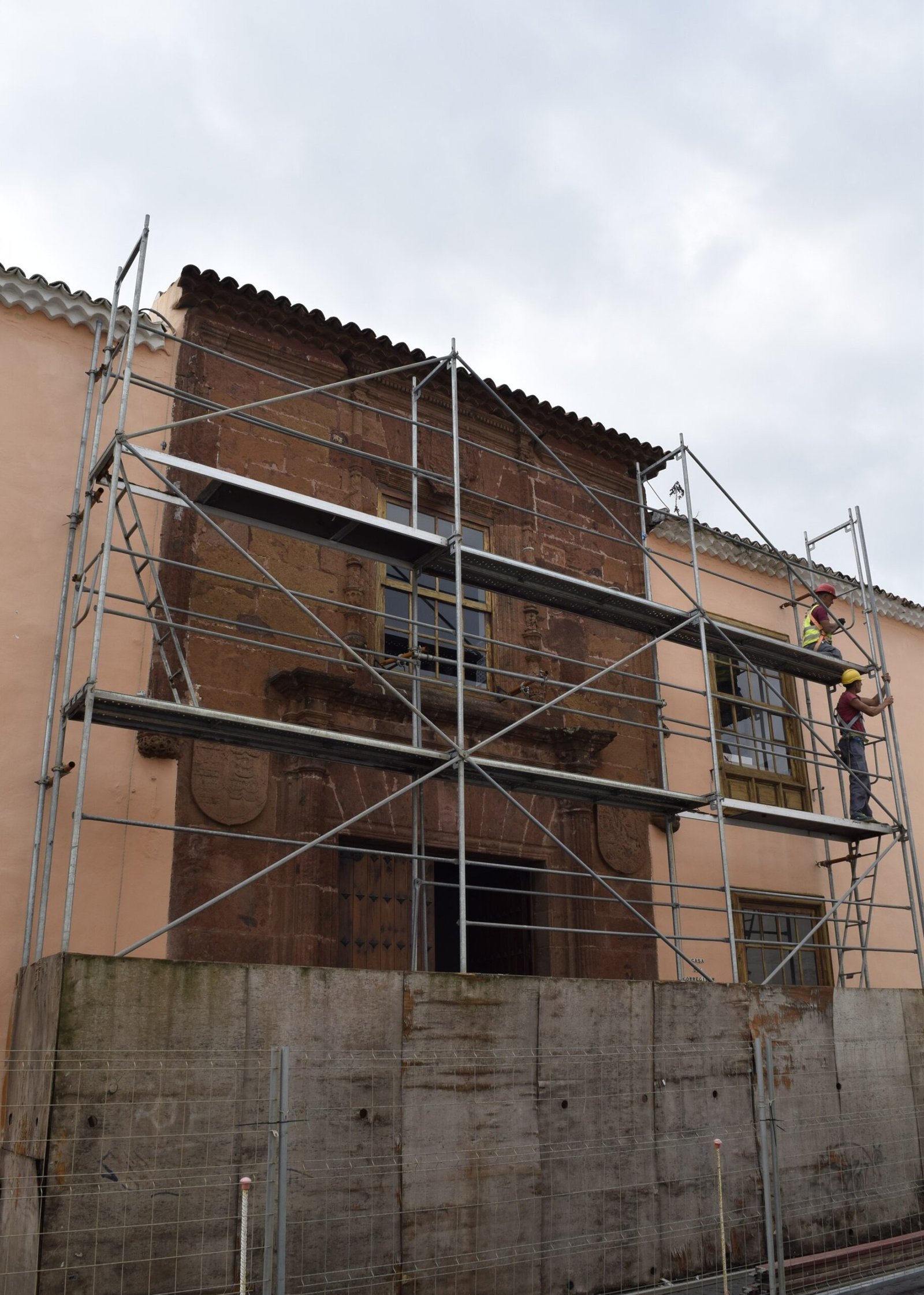
The Municipality of La Laguna has started the process for the restoration of the Casa del Corregidor’s facade, one of the most valuable monumental facades in the Archipelago, which has been covered with scaffolding since 2017 to protect its fragile state of conservation. The intervention, carried out by the Canarian Foundation of the University of La Laguna, has a budget of 133,750 euros and a 7-month execution period.
The Mayor of La Laguna, Luis Yeray Gutiérrez, celebrates «the beginning of a project that will allow us to preserve one of the historical symbols of our city» and ensures that «the restoration of the Corregidor’s facade is one of the main commitments of this Government group in terms of monumental heritage. We have a highly qualified technical team for this task, which will allow us to carry out this intervention with the utmost respect for authenticity and the original material.»
In the same vein, the Councillor of Works, Infrastructure, and Accessibility, Ángel Chinea, emphasized «the technical complexity involved in the conservation and restoration process of the facade, due to the advanced state of deterioration of the monument.»
In this regard, the councillor explains that the deterioration of the facade is not only due to the nature of the material and its aging, but also to the climatic agents to which it is exposed, with continuous temperature changes and high relative humidity. Facing northeast, the facade barely receives direct sunlight, exposing it to moisture and north winds that accelerate the erosion of the stone.
During this week, the dismantling of the old scaffolding and the placement of a new structure will take place before starting the restoration work next Monday. The intervention process will be carried out in different phases, starting with the analysis and consolidation of the stone and the removal of cement mortars and non-constituent elements of the facade.
It will also involve the dismantling of one of the ashlar stones to make a new adhesion according to current restoration criteria, the bonding of stone breaks, and the stitching of stone fragments. There will also be a superficial cleaning of the stone and the removal of biological elements. Subsequently, crack and joint sealing, filling of microcracks with liquid mortar, and volumetric reintegration of gaps and ashlar stones will be carried out.
The treatment of the metals that are part of the ensemble and the preservation of the entire facade through the application of a water repellent will complete the final steps of the restoration process.
The objectives of this intervention are aimed at stopping the damage and causes of deterioration. To this end, upon completion of the restoration work, a preventive conservation plan will be developed, establishing the parameters to follow and the necessary periodic surveillance and minimal intervention actions. As a complement to the restoration process, a scale model and an informative video will be produced.
Plateresque Facade
The facade, made of red volcanic stone, is the only original element still preserved in the building, one of the oldest in the city. Among its most characteristic elements are three shields of high historical-documentary value: the imperial one of Charles V, the city’s shield, symbol of the Council, and the coat of arms of the Sotomayor family, as the work was completed under the governance of Jerónimo Álvarez de Sotomayor.
The Casa del Corregidor was part, along with the Casa del Concejo, of the city’s government houses, the highest expression of political and jurisdictional power, with authority over the entire insular area. Built between 1540 and 1545, its facade is the oldest example of Plateresque style in the Archipelago. Plateresque, also known as «Roman» in the texts of the time, resulted from the combination of early Renaissance influences with the dominant architectural tradition until then, mainly Gothic and Mudejar.
This facade combines elements of classical affiliation, such as the semicolumns of composite order and the lintel of the first body, with others of Mudejar influence, such as the alfiz framing the ensemble, or Gothic, such as the atrepanadas corbels.
The current measurements of the facade do not correspond to the original measurements, as the lower area is partially hidden by several coatings. From the ground to the bottom of the eaves, it reaches 8.80 meters, with a width from the outer limits of 6 meters and a total area of 52 square meters.